



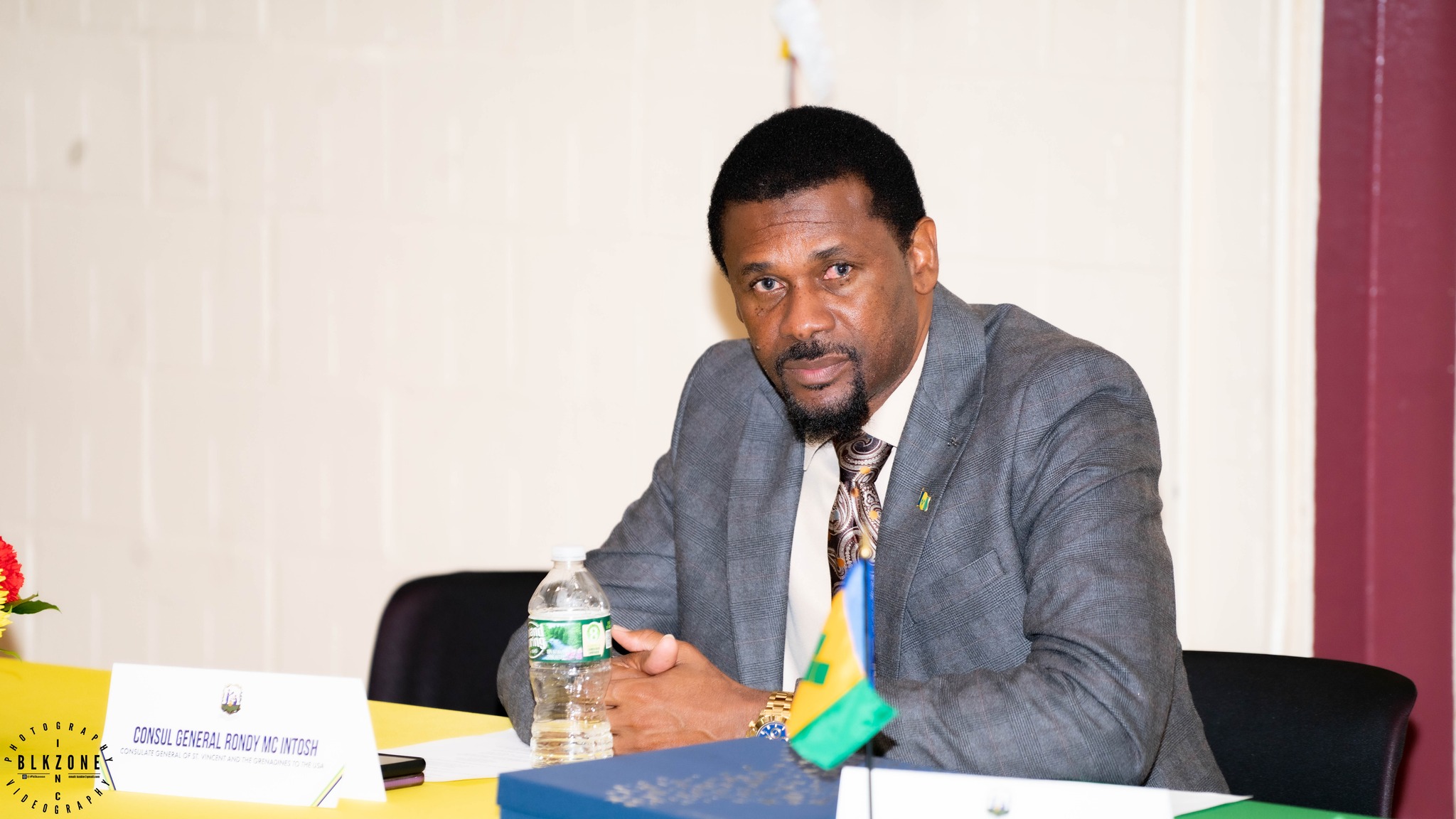
A developing investigation into the complete erasure of computer systems at St. Vincent and the Grenadines’ Consulate in New York is expected to bring former Consul General Rondy “Luta” McIntosh into focus, as authorities seek answers to what officials have described as a deeply troubling breach of institutional continuity.
The issue, first disclosed in Parliament earlier this week, has quickly escalated from a concerning administrative setback into a matter of potential accountability, with Foreign Affairs Minister Fitzgerald Bramble confirming that McIntosh will be questioned as part of the ongoing probe.
While the Minister has not personally contacted the former diplomat, he made it clear that engagement is inevitable.
“No, I have not spoken to him, but trust me, he will be spoken to,” Bramble said during a radio interview, signaling that investigators will be pursuing direct clarification from those previously in charge of the mission.
The controversy stems from revelations by newly appointed Consul General Roland U.C. “Patel” Matthews, who reported that upon assuming office in early March, he found a complete absence of data across the consulate’s computer systems.
According to Matthews’ account, there were no digital records, no correspondence, and no operational files—effectively leaving the mission without any electronic institutional memory.
The discovery has raised immediate and serious concerns within government, particularly given the critical role consulates play in managing visa services, diaspora relations, and bilateral engagement.
Bramble has urged caution as investigations continue, noting that key details remain unclear, including whether the wipe affected a single machine or an entire network.
“We are still trying to determine the scope,” he said, adding that technical assessments may be required to fully understand what occurred.
He also pointed out that two permanent staff members remained at the consulate during the transition period, though it is not yet known what level of access they had to the systems in question.
The Minister revealed that he was informed of the situation roughly two weeks ago and has since moved to initiate a structured response, including the possibility of bringing in technical experts to assist with the investigation.
Despite the mounting concern, Bramble has maintained that his approach is grounded in transparency rather than political targeting.
“This is not about rubbishing anybody,” he previously told Parliament. “It is about letting the people know what we inherited and what we are dealing with.”
Still, the implications are significant. The absence of records has forced the new consular team to rebuild operations from the ground up, complicating routine functions and delaying broader diplomatic objectives at a time when the government is attempting to recalibrate its foreign service for greater efficiency and measurable outcomes.
Bramble confirmed that reviews are now underway across all overseas missions as part of a wider effort to strengthen governance, data management, and accountability within the diplomatic corps.
Whether the investigation will lead to disciplinary or criminal action remains an open question. The Minister declined to speculate, emphasizing that any such determination will depend entirely on the findings.
For now, the focus remains on establishing the facts—how the data was erased, under whose authority, and whether proper procedures were followed.
As the probe unfolds, attention is expected to center not only on the actions taken during the final days of the previous administration’s tenure at the consulate, but also on the systems—or lack thereof—that allowed such a situation to occur.
What began as a disclosure in Parliament has now evolved into a test of transparency, oversight, and institutional resilience—one that could have lasting implications for how St. Vincent and the Grenadines manages its presence abroad.

2 Comments
4c9bco
2fq49t