

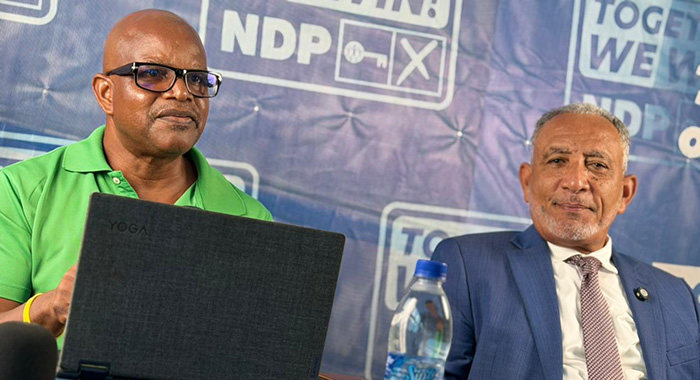
As debate continues to swirl around claims that Prime Minister Godwin Friday and the New Democratic Party (NDP) promised public servants a “double salary,” one question stands above all the noise — did public servants ever receive a double salary during the Unity Labour Party’s 25 uninterrupted years in government?
The question is not rhetorical. It goes to the heart of fairness, political honesty, and selective outrage.
For weeks now, social media platforms, and comment sections have been flooded with criticism from ULP supporters who argue that the new administration misled voters by promising more than it can deliver. Some insist that a full double salary was guaranteed, while others accuse the NDP of backtracking barely weeks after taking office.
Yet missing from much of this criticism is historical perspective.
From 2001 to 2024, the ULP governed St. Vincent and the Grenadines with near-total political dominance. That period included times of economic growth, international assistance, post-disaster recovery funding, and relative fiscal stability. If there was ever a government with both the time and opportunity to institutionalise a double salary or routine bonus policy for public servants, it was the ULP.
But it never happened.
Public servants under the ULP experienced long stretches of wage stagnation, delayed salary negotiations, and incremental increases that were often outpaced by rising living costs. Bonuses, when offered, were occasional and framed as relief measures rather than entitlements. They were never presented as a guaranteed “double salary,” nor did the public discourse demand one.
And yet, for most of those 25 years, there was little outrage from party loyalists.
Fast forward to today.
The NDP, fresh out of opposition and barely weeks into office, finds itself under intense scrutiny. During the campaign, the party spoke about salary bonuses and financial relief for public servants — language common to election seasons everywhere. As political momentum grew and enthusiasm surged, those statements took on larger meanings in the public imagination. For some supporters, “bonus” quickly became synonymous with “double salary.”
That interpretation, however, was never tested against policy details, budget realities, or timelines.
Now, instead of allowing space for clarification and implementation, critics have rushed to frame the situation as deliberate deception. The irony is hard to ignore: many of the loudest voices accusing the NDP today were silent while public servants waited years for concluded salary agreements under the previous administration.
This moment exposes a deeper issue in Vincentian politics — how promises are remembered depending on who makes them.
When the ULP governed, missed expectations were often explained away as economic constraints or global pressures. Today, similar realities are dismissed outright when applied to the NDP. This double standard undermines genuine accountability and turns political debate into partisan theatre.
It is also important to acknowledge political reality. A new government inherits not just authority, but also debt, commitments, contractual obligations, and a public service structure shaped by decades of policy decisions. Responsible governance requires assessment before execution. No serious administration can distribute large sums of public money without understanding the full state of the treasury it has inherited.
That reality may be inconvenient, but it is not deceptive.
None of this absolves the NDP of responsibility. Clear communication matters. Expectations must be managed. Campaign language must be matched with transparency in governance. But criticism must also be honest and historically consistent.
If double salary payments are now the standard by which governments are judged, then Vincentians must ask why that standard was never applied during 25 years of ULP rule.
The current debate is not simply about a bonus or a payslip. It is about how political loyalty shapes memory, how outrage is deployed selectively, and how easily context is discarded when power changes hands.
At its core, the controversy invites reflection rather than accusation.
Because before pointing fingers at a government barely settling into office, the country must answer one simple, uncomfortable question:
Have you ever received a double salary in 25 years under the ULP?
This article represents commentary and analysis. The views expressed are those of the writer and do not necessarily reflect the views of Cliplet News or its affiliates.

4 Comments
Excellent misdirection!
The issue is not whether ULP ever gave… the issue is that ULP delivered on what promises it made, did not make promises it could not keep, and it is now telling that the NDP is fooling the masses with various empty promises.
zeib75
h35dwv
zzsvqc