



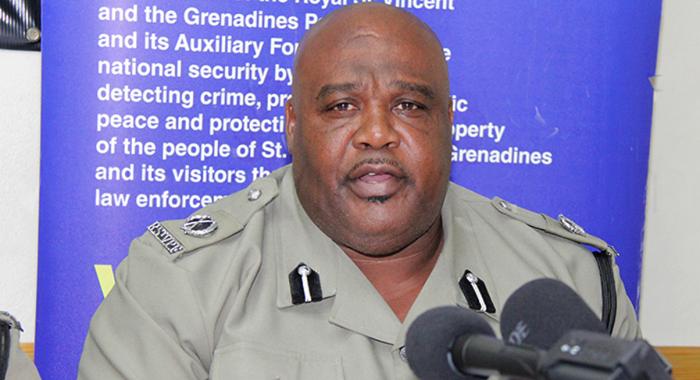
The Royal St. Vincent and the Grenadines Police Force (RSVGPF) is facing one of its most significant public credibility challenges in recent years, as allegations of false testimony against Assistant Commissioner of Police Trevor “Buju” Bailey ignite widespread calls for his resignation and a comprehensive restructuring of the force.
The accusations stem from activist Adriana King, who claims Bailey provided factually incorrect and deliberately misleading statements in her long-running criminal case related to the August 5, 2021 protest outside Parliament.
King alleges that Bailey’s sworn testimony misrepresented her location, the timeline of events, and even a conversation he attributed to August that she says occurred more than a month earlier.
She argues that this repositioning of facts was aimed at strengthening the case that she obstructed the Prime Minister’s entrance to Parliament — a charge she has consistently denied.
“A danger in police uniform” — the activist’s charge
In a series of public posts and statements, King did not mince words.
“It hits me more and more how dangerous it is to have a person like Trevor Buju Bailey in police uniform,” she wrote, asserting that video evidence contradicts Bailey’s narrative.
She said Bailey himself acknowledged in a recorded statement that she was at the main gate, not the entrance the Prime Minister used. Yet, she claims, his witness report places her near the Prime Minister in order to strengthen a prosecution she describes as politically motivated.
She further alleges that she was prevented from presenting video footage that would have contradicted the police account.
A pattern or an isolated case? Calls for a broader review
While Bailey has not publicly responded to King’s specific allegations, the situation has reignited long-standing concerns about police accountability and oversight in St. Vincent and the Grenadines.
Earlier this year, Bailey himself acknowledged that there are “legitimate concerns about police investigating themselves,” a remark that activists say now underscores the urgency of independent intervention.
Civil-rights advocates argue that if a senior officer is accused of manipulating evidence for a politically powerful outcome, every case in which he has played a major role may require review.
“An allegation like this cannot remain internal,” a regional security expert told this publication.
“Cases involving senior police testimony should be reviewed by independent oversight bodies, not the police hierarchy itself.”
Should the police force be reshuffled? Debate heats up
The controversy has intensified calls from activists, lawyers, and opposition figures for a major reshuffle of the RSVGPF, particularly within upper ranks.
Critics argue that:
- Leadership credibility has been eroded
- Public trust in policing is at a low point
- Political neutrality must be restored
- Oversight bodies need more power
- Internal disciplinary systems lack transparency
Several commentators have suggested that if Bailey does not step aside temporarily, the government should intervene to prevent erosion of confidence in law enforcement.
Independent investigation now “unavoidable,” experts say
The growing chorus insists on an independent probe involving either:
- A regional CARICOM-level investigative team,
- A judicial inquiry, or
- An ombudsman-led review with access to all case files and video evidence.
Legal observers note that if evidence emerges showing discrepancies between Bailey’s statement and video recordings, the implications could extend far beyond King’s case, possibly affecting:
- Past protest-related prosecutions
- Internal promotion decisions
- Public trust in the judicial system
- The political neutrality of police operations
The human cost: Four years without full income
For King, the accusations are not just institutional — they are deeply personal.
She says she has been blocked from her job for nearly four years, surviving on half-salary while the officer she accuses has been promoted.
“For Buju alone, my child and I should be under a culvert sleeping,” she wrote. “Never happen.”
Her supporters argue that the prolonged legal process and professional sanctions reflect a pattern of state retaliation against outspoken activists.
What happens next?
With mounting public attention, the issue is unlikely to subside.
Key questions now dominating national debate include:
- Should Assistant Commissioner Bailey be suspended pending investigation?
- Will an independent inquiry be launched?
- Can the RSVGPF restore public trust without leadership changes?
- Should cases involving Bailey’s testimony be reopened or reviewed?
For many Vincentians, the controversy has become a test of transparency, justice, and the independence of state institutions.
As one activist put it:
“This is bigger than Adriana King. This is about whether the police can be trusted with the truth.”
This article is based on information currently available in the public domain, including statements made by individuals, commentary shared on social platforms, and ongoing public discussions. The allegations referenced are claims, not established facts, and all persons mentioned are presumed innocent unless proven otherwise in a court of law. Our publication does not assert the guilt, misconduct, or intent of any party. We remain committed to accuracy, fairness, and responsible reporting. Any party referenced in this article is welcome to provide a response or clarification, which we will publish in accordance with our editorial standards.


