



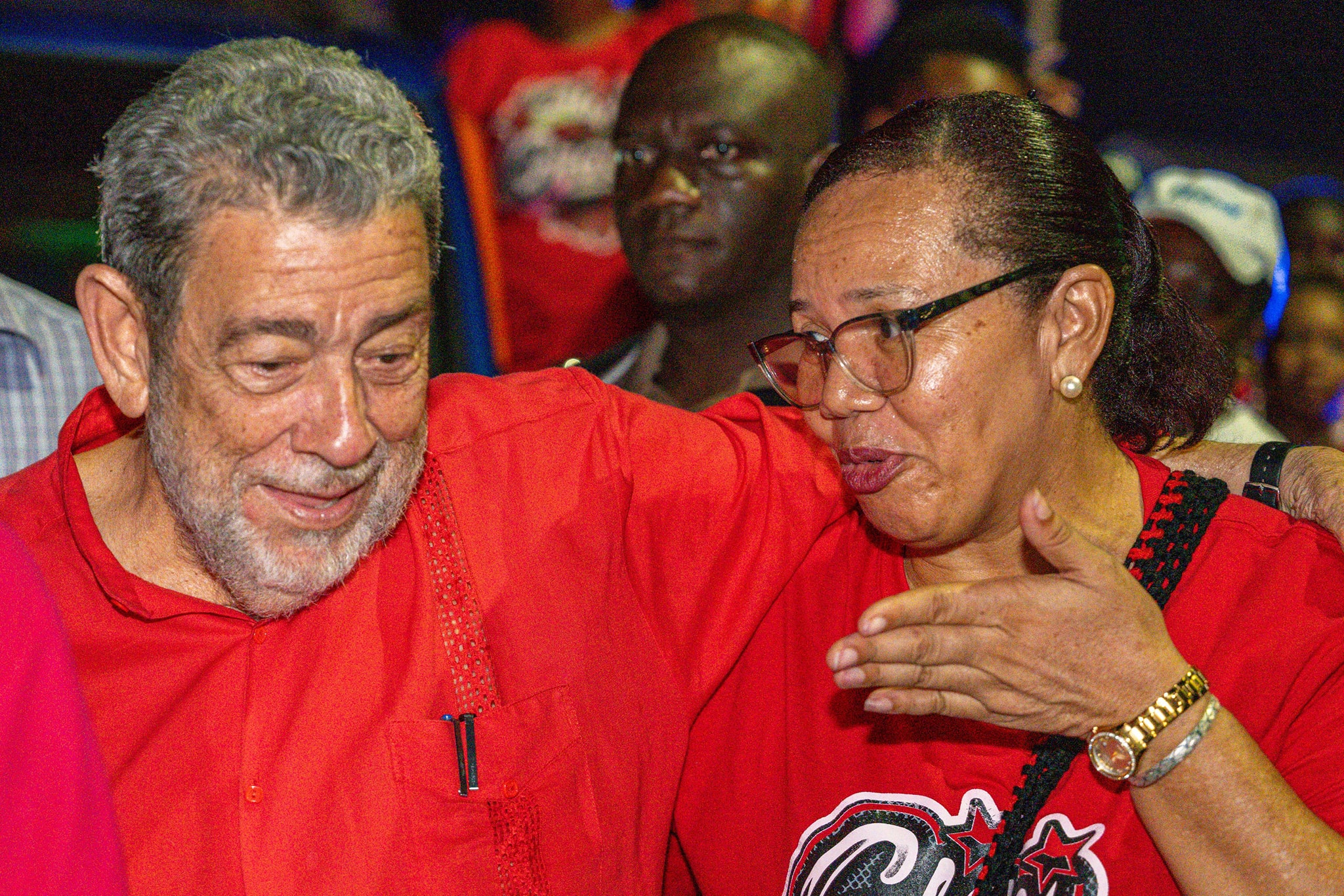
Opposition Leader Ralph Gonsalves has reiterated that no Prime Minister or government minister has the legal authority to hire, fire, or arbitrarily remove public officers, using the case of Grace Walters as a clear example of how constitutional safeguards protect public servants.
Speaking last week, Gonsalves emphasized that electoral victory does not give any political party unchecked power over the public service.
“Winning an election does not mean unrestrained, unshackled, unbounded executive authority,” he said, adding that all power is limited by the Constitution, laws, and regulations.
He stressed that the responsibility for appointing, transferring, disciplining, or removing public officers lies with the Public Service Commission and the Police Service Commission, not with politicians.
According to Gonsalves, while a Prime Minister may be consulted in the appointment of Permanent Secretaries and may exercise limited influence, including a veto in some circumstances, no Prime Minister can impose a decision unilaterally.
“This country is a government of laws, not of men,” he said. “Influence is not the same as power, and no one can operate outside the constitutional framework.”
Addressing misconceptions about ministerial authority, Gonsalves dismissed the idea that ministers can simply order changes within the public service.
“Ministers have administrative authority, not absolute power,” he stated. “They cannot talk something into being or act on a whim.”
Using Walters’ situation as an example, he explained that she could not be transferred to a position below her B2 grade or have her professional status reduced. Any movement, he said, had to respect her rank and conditions of service.
“In her case, the government had to create an entirely new, equivalent post in the estimates because there was no suitable position available,” Gonsalves said. “They could not lawfully place her in a lesser role.”
He also addressed the appointment and removal of senior police officials, noting that although the Constitution involves the Prime Minister in matters concerning the Commissioner and Deputy Commissioner of Police, these officers cannot be dismissed at will.
Removal, he said, requires specific grounds such as misconduct or physical or mental incapacity and must follow strict legal procedures.
Within the police force, Gonsalves noted that the Commissioner oversees promotions from Constable to Sergeant, while decisions on higher ranks are made by the Police Service Commission.
He warned against attempts by administrations to marginalize officials they dislike by sending them to undesirable or obscure postings, often referred to as the “administrative equivalent of Siberia.”
“Even those transfers must go through the Public Service Commission,” he said. “It is not a body that bends easily to political pressure.”
Responding to online calls for public officers to be fired, Gonsalves said such demands ignore the legal protections built into the system.
“Crazies on the internet may call for someone to be removed,” he remarked, “but the law exists to shield public servants from arbitrary political action.”
He concluded that the case involving Walters demonstrates the importance of respecting constitutional boundaries and maintaining professionalism in the public service.
“Our system is designed to protect fairness, independence, and stability,” Gonsalves said. “That is how good governance is preserved.”


