



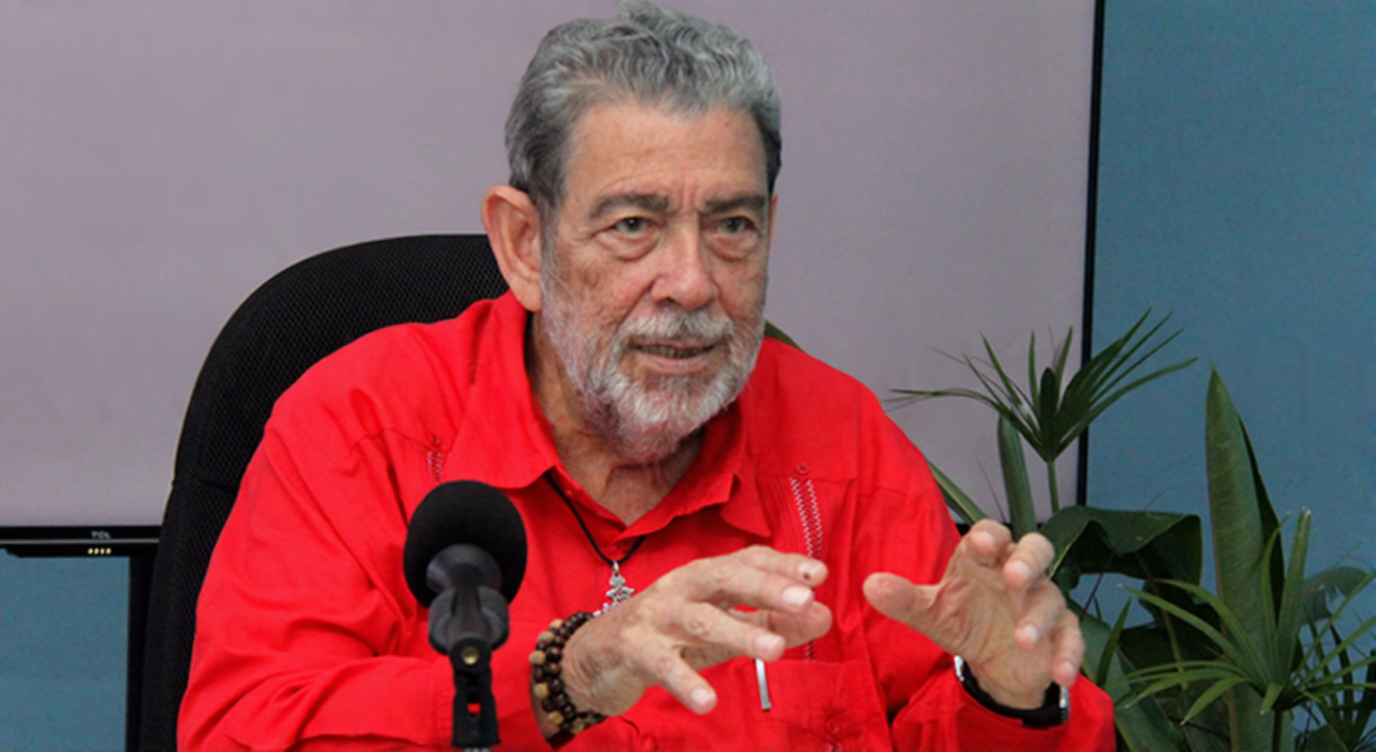
Opposition Leader Dr Ralph Gonsalves says he intends to complain to CARICOM and the Commonwealth about Brenton Smith’s appointment as acting assistant commissioner of police, arguing that the move has brought partisan politics into the upper command of the national constabulary.
Gonsalves, a former prime minister and minister of national security, used his Wednesday radio broadcast to mount his strongest attack yet on Smith’s rapid rise through the Royal St Vincent and the Grenadines Police Force.
The police force announced that Smith began acting as assistant commissioner on Monday, Aug. 17. Trevor “Buju” Bailey and Junior Simmons also took up acting appointments as commissioner and deputy commissioner, respectively.
Gonsalves said his objection was not to a change of leadership but to Smith’s elevation, which he alleged was driven by political loyalty rather than the usual considerations of experience, seniority and merit.
Smith, a career police officer, was among public-sector workers dismissed in 2021 after refusing to comply with the former Unity Labour Party government’s COVID-19 vaccine requirement for frontline employees. He later became general secretary of the then-opposition New Democratic Party and returned to the police force after the NDP won the November 2025 general election.
Recalling that Smith held the rank of station sergeant five years ago, Gonsalves questioned how he could move into one of the force’s most senior offices ahead of officers who had remained in service and progressed through the intervening ranks.
Smith had returned as an inspector before being appointed to act as assistant commissioner. Gonsalves argued that the move allowed him to pass over the ranks of assistant superintendent and superintendent, as well as officers who had already served substantively at those levels.
He described Smith as a “politician in uniform” and said that perception would follow the acting ACP into his dealings with junior officers and the rest of the high command.
The opposition leader also claimed the appointment could create friction inside the force, especially if Smith were given influence over personnel decisions and future promotions. Reports that Smith would be assigned responsibility for human resources had formed part of Gonsalves’ earlier criticism of the planned appointment.
His concerns extended beyond the police force. Gonsalves said regional crime and security bodies, along with international partners such as the United States Drug Enforcement Administration and Federal Bureau of Investigation and British and French agencies, depend on discretion when sharing sensitive information.
He argued that any perception of political control at the top of the force could make those partners more cautious about passing intelligence to St Vincent and the Grenadines. Gonsalves did not present evidence that any agency has suspended or reduced cooperation.
Gonsalves also criticised the Police Service Commission and singled out its chair, Laura Anthony Brown, whom he described as a friend and respected public servant. He said he could not understand how the commission had approved an appointment that, in his view, placed political affiliation above the established promotional structure.
At the same time, the opposition leader sought to separate his criticism of the appointment from his personal relationship with Smith. He recalled exchanging a cordial greeting with the senior officer after the funeral of Lennox John at the Anglican Cathedral, saying he bore him no personal ill will.
Gonsalves also said he had no comparable objection to the appointments of Bailey and Simmons, describing them as professional officers who had advanced through the force.
Smith’s public remarks on Thursday did not address Gonsalves’ allegations. Speaking in his new role with responsibility for crime-fighting, he promised a more coordinated and intelligence-led response to serious crime while insisting that officers would act firmly, lawfully and professionally.
Gonsalves did not say when his letters to CARICOM and the Commonwealth would be sent or what specific intervention he would request. His announcement, however, pushes the dispute beyond an internal promotion debate and raises the prospect of the police leadership controversy being taken before regional and international institutions.


