



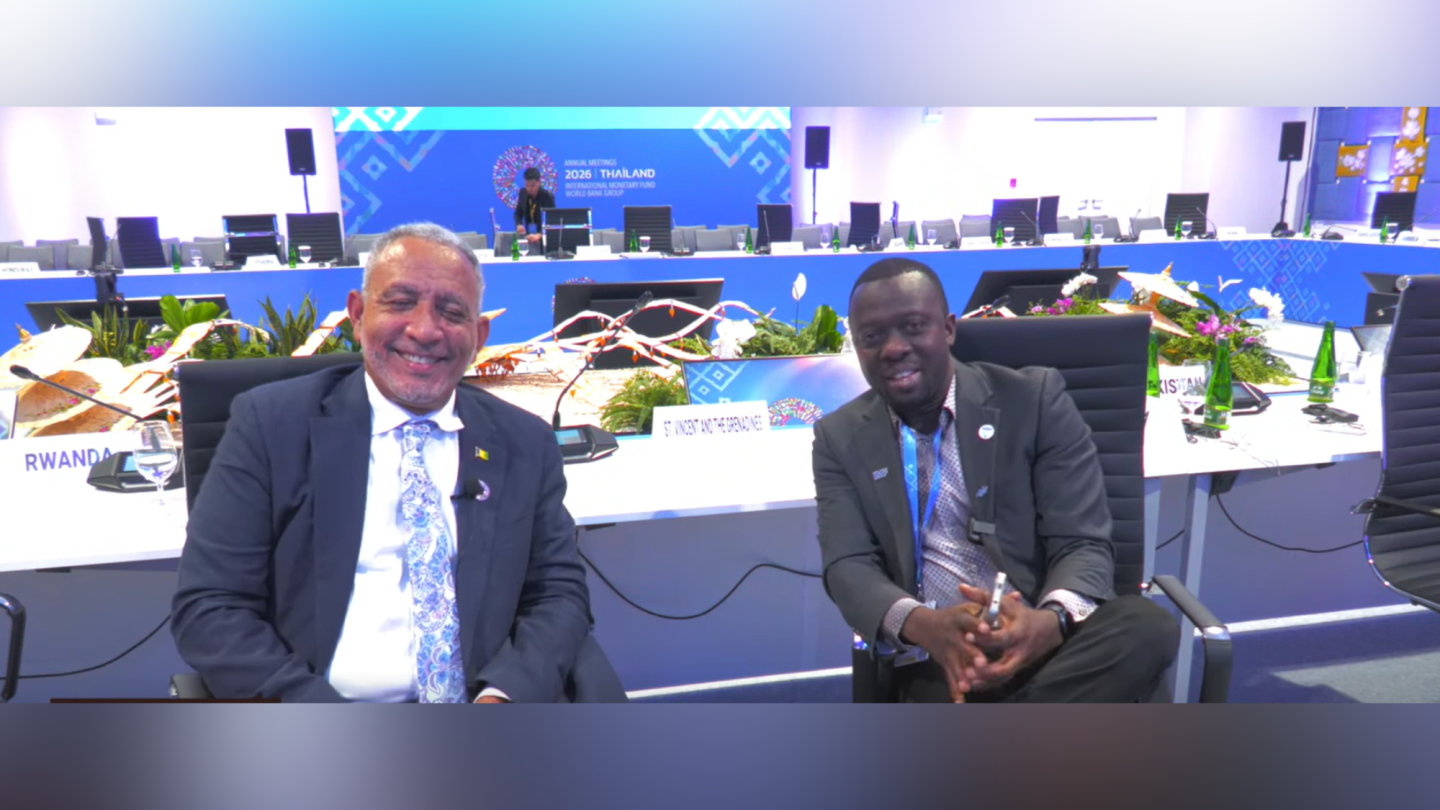
Prime Minister Dr. Godwin Friday has confirmed that St. Vincent and the Grenadines (SVG) intends to move forward with a new citizenship investment programme, despite growing international concerns over such initiatives.
Dr. Friday made the disclosure during an interview with Andre Huie, Managing Director and News Editor of Television Caribbean, in Bangkok, on the sidelines of the 2026 International Monetary Fund (IMF) and World Bank Group meetings.
The Prime Minister said a consultancy is currently working on the design of the programme, with the government targeting the first quarter of 2027 for a possible launch.
“We intend to proceed with a similar type programme,” Dr. Friday stated. However, he emphasized that the proposed initiative would not operate as a Citizenship by Investment Programme (CBI) in its traditional form.
Dr. Friday explained that the proposed programme would feature more rigorous due diligence procedures and stronger central oversight. The initiative is expected to be coordinated through the Organisation of Eastern Caribbean States (OECS), with the Eastern Caribbean Central Bank (ECCB) playing a role in monitoring the system.
The government is also continuing discussions with the European Union (EU) and other countries that have raised objections to citizenship investment programmes. According to the Prime Minister, these discussions are intended to establish safeguards that would allow SVG to attract investment while addressing international concerns about security, transparency and programme integrity.
He noted that other Eastern Caribbean countries operating similar programmes are also considering adjustments to their existing arrangements. Dr. Friday expressed hope that these changes, alongside continued dialogue with international partners, could lead to what he described as a “productive resolution” of the ongoing dispute.
The government’s proposed approach appears to place greater emphasis on attracting investment under strengthened regulatory controls rather than simply granting citizenship in exchange for financial contributions.
The announcement comes as the government faces significant fiscal challenges, with public debt placing considerable pressure on the country’s finances.
Dr. Friday said his administration inherited what he described as a “very difficult fiscal situation”, with public debt standing at approximately 113 per cent of gross domestic product (GDP). He identified debt management and the creation of fiscal space as key priorities for the government.
The IMF’s July 2026 Article IV report similarly placed SVG’s public debt at 113 per cent of GDP in 2025, describing the country’s debt position as unsustainable.
According to the report, public debt has increased by 45 percentage points of GDP since 2019, with approximately half of that increase occurring over the past two years. The IMF further projected that, without decisive policy changes, the debt-to-GDP ratio could rise to 145 per cent by 2031.
The Fund attributed the increase to several factors, including the COVID-19 pandemic, the 2021 La Soufrière volcanic eruption, Hurricane Beryl and substantial capital expenditure.
Against this backdrop, the government is seeking ways to generate additional capital while managing its existing financial obligations.
The Prime Minister also highlighted the continuing economic and social consequences of recent natural disasters.
Dr. Friday said Hurricane Beryl destroyed an estimated 22 per cent of the country’s GDP, leaving significant damage to homes, businesses and communities, particularly in the southern Grenadines.
Recovery efforts remain ongoing, with the government continuing to support reconstruction and help affected residents return to their homes. Work is also continuing on projects associated with the 2021 volcanic eruption, including initiatives supported by the World Bank.
Meanwhile, rising energy costs have presented another challenge for households and businesses.
Dr. Friday said temporary measures, including extended arrangements involving the electricity company, have helped cushion the impact of higher energy prices. However, he acknowledged that such subsidies cannot be sustained indefinitely.
The Prime Minister argued that limited public resources would be better directed towards productive investments capable of stimulating economic growth and creating employment opportunities.
The proposed citizenship investment programme could provide the government with another avenue for attracting capital as it seeks to strengthen public finances and support national development.
However, its implementation will depend partly on the government’s ability to establish credible safeguards and address the concerns of international partners, particularly those relating to security, due diligence and oversight.
Dr. Friday’s comments represent a clear indication that his administration intends to pursue the initiative, with the first quarter of 2027 identified as the target period for a possible launch.
Further details about the programme’s structure, eligibility requirements, investment thresholds and regulatory framework have yet to be outlined publicly.
As planning continues, attention is likely to focus on how the government intends to balance the need for investment with the demands of international scrutiny and the country’s broader economic challenges.


